History & Heritage
8 min read
The 1958 Tybee Bomb: Georgia's Lost Nuclear Weapon
In February 1958 a Mark 15 hydrogen bomb was dropped into Wassaw Sound after a midair collision off Savannah. It was never found. Here is what the record says, where it still disagrees with itself, and what you can actually see today.
Edited by Sandcastle Inn Editorial Team
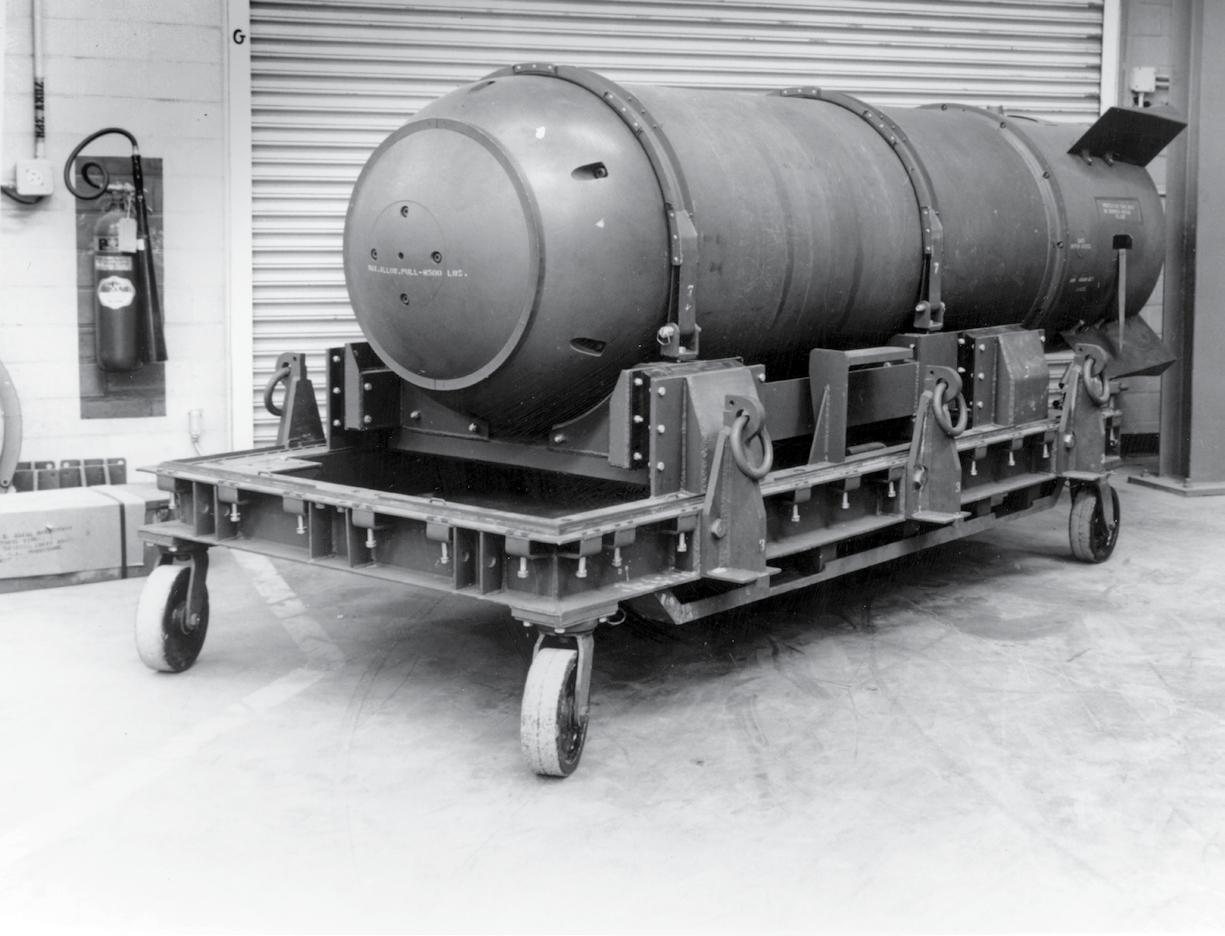
Photo by U.S. Atomic Energy Commission on Wikimedia Commons · Public domain
The most surprising thing about the Tybee bomb is how little of it is legend. A hydrogen bomb really did go into the water off this coast in 1958, the government really did search for it for more than two months, and the government really did give up. Nothing has been brought up since.
Most of what circulates about it online is either breathless or vague. This is the version built from the Defense Department's own narrative summary, the Air Force's 2001 study, and the documents those two lean on. Where those documents disagree, we say so and say who is saying what.
One thing up front, because it shapes everything else: there is nothing to visit. No marker, no wreck, no dive site. What you can do is understand what happened a short drive from Butler Avenue, and then go look at the water it happened over.
The night of February 5, 1958
The date matters, because a few secondary lists give February 12. The mishap report and the Air Force documents support February 5.
It was a night exercise. A Boeing B-47B Stratojet, flown by Col. Howard Richardson, was on a simulated combat mission out of Homestead Air Force Base in Florida. Near Savannah, a USAF F-86 fighter piloted by Lt. Clarence Stewart collided with it.
Stewart ejected and came down near Estill, South Carolina. Richardson kept the crippled B-47 flying, and it was carrying a Mark 15 bomb of about 7,600 pounds.
That is the problem the crew faced. Landing a damaged aircraft with a weapon of that kind aboard risked a high-explosive detonation on the runway. So the bomb was jettisoned over the Wassaw Sound area, which sits off Tybee. One account puts the drop at about 7,200 feet.
Richardson then brought the bomber down safely at Hunter Air Force Base in Savannah. He later received the Distinguished Flying Cross.
Where, exactly
"Wassaw Sound" is the answer the 2001 Air Force study and most sources give. The 1980 Defense Department narrative summary is looser, describing the location as several miles from the mouth of the Savannah River. Both descriptions are in the record, and neither comes with a pin on a map. If you see precise coordinates quoted on a website, treat them as someone's guess.
The search
Air Force explosive ordnance disposal teams went looking, joined by roughly 100 Navy personnel. They worked with sonar and cable sweeps.
It ran from early February until April 16, 1958, when the search was called off. The Defense Department's summary uses a phrase worth quoting: the bomb was "considered to be irretrievably lost."
That was the end of the active effort. What followed was decades of the question coming back up.
Did it have a live core?
This is the part of the story with a real, documented disagreement, and it is the part most retellings flatten into one answer or the other. Here are both, with their sources.
The Air Force position is that the weapon could not produce a nuclear explosion because the nuclear capsule had been removed before the flight. It points to an Atomic Energy Commission custody form, AL-569, released under the Freedom of Information Act, which records a simulated lead cap of about 150 pounds rather than a plutonium capsule. It also cites a Strategic Air Command history stating that alert flights in February 1958 with older Mark 15 bombs were not authorized to carry capsules. That approval came in June 1958.
The counter-evidence is a letter dated April 22, 1966, from Assistant Secretary of Defense W. J. Howard to the Joint Committee on Atomic Energy. In it, the weapon is described as "a complete weapon, a bomb with a nuclear capsule."
Those two sets of documents do not fit together, and no later document has reconciled them. We are not going to pick one for you. The record conflicts, and that is a more accurate thing to tell you than a confident answer in either direction.
It is also worth being clear about what this dispute is not. It is not a reason for alarm on a beach day. The same official position, discussed below, is that the bomb is best left alone, and it has lain in the silt for decades.
What the government says about it now
In 2001, an Air Force Nuclear Weapons and Counterproliferation Agency study, dated April 12 of that year, took the question up again. It reported the Department of Energy's estimate that the bomb lies beneath 5 to 15 feet of silt in Wassaw Sound. Its conclusion was that, left undisturbed, the weapon poses no significant hazard.
In practice that means the official position favors leaving it exactly where it is. The 2001 report is hosted at nukestrat.com if you want to read the document rather than a summary of it.
The 2004 search
The story had one more chapter. Derek Duke, a retired lieutenant colonel, picked up an elevated radiation reading about a mile offshore, and that prompted a government search in 2004. It found nothing. The Air Force attributed Duke's reading to naturally radioactive monazite, not the weapon.
So the sequence is short. A bomb went in, a two-month search came up empty, a 2001 study said leave it, and a 2004 search found no sign of it. The mystery is real in the sense that nobody knows the exact spot. It is not real in the sense of an ongoing hunt.
The timeline at a glance
If you want the whole thing in one place, the dated points in the record are these:
- February 5, 1958: the F-86 and B-47B collide near Savannah. The Mark 15 is jettisoned over the Wassaw Sound area. The bomber lands at Hunter Air Force Base.
- February to April 1958: Air Force and Navy teams search with sonar and cable sweeps.
- April 16, 1958: the search is called off and the bomb is considered irretrievably lost.
- April 22, 1966: the Howard letter to the Joint Committee on Atomic Energy describes a complete weapon with a nuclear capsule.
- April 12, 2001: the Air Force study reports the 5 to 15 feet of silt estimate and finds no significant hazard if the bomb is left undisturbed.
- 2004: a government search prompted by Derek Duke's radiation reading finds nothing.
Notice how much of that comes from government documents rather than from witnesses or local lore. That is why this story is easier to tell accurately than most "lost treasure" tales. It is also why the one genuine dispute, the capsule, stands out so sharply: it is a disagreement between official papers, not between a document and a rumor.
What you can see today
Not the bomb. We said it at the top and it deserves repeating here: it is not recoverable and it is not visitable. There is no wreck on the seabed, no buoy, and no tour that takes you to it.
This post does not point you to a bomb marker or museum exhibit, because we have not found one to point to.
What Tybee does have is a very good place to learn about the island's wider history. The Tybee Island Light Station and Museum, run by the Tybee Island Historical Society, sits at Fort Screven by the lighthouse at the island's north end. The tower, the keepers' cottages and the museum tell a much longer story than 1958. We cover that in detail in our Tybee Island Light Station guide, and the Light Station's official site has current hours and admission, which change by season.
Getting there
Tybee Island is about 18 miles from Savannah, a 20-to-30-minute drive east on US-80, the only road onto the island. The Sandcastle Inn is on Butler Avenue, a five-minute walk from the beach, with free parking for one car per room. On the island, public parking is metered and enforced, so the lighthouse trip is easier from a base where the car can stay parked.
Dogs are welcome at the inn, but not on any Tybee beach. That is a city ordinance, so plan the shoreline part of the day accordingly. Our dog-friendly things to do post covers the rest of the island.
Why the story holds up
Part of why it keeps getting retold is the sheer unlikelihood of the pieces. A routine night exercise, a collision, a decision made in minutes, a weapon lost in an ordinary-looking stretch of Georgia water. Part of it is the paperwork: the official record is detailed, and the places where it contradicts itself are specific enough to cite.
Part of it is that the answer to "where is it" has stayed the same for more than sixty years. Somewhere under the silt in Wassaw Sound, and the official position is to leave it there.
For the rest of your trip, our things to do on Tybee page is the easier place to start. If you would like to stay a few nights while you work through the island's history, see what is on at our special offers page.
Sources
FAQ
Common questions.
Is there really an H-bomb off Tybee Island?
Yes. A Mark 15 thermonuclear bomb was jettisoned over the Wassaw Sound area on February 5, 1958. This followed a midair collision between an F-86 fighter and a B-47 bomber. The 1958 search was called off on April 16, 1958, and the bomb was considered irretrievably lost. It has never been recovered.
Was the Tybee bomb armed with a nuclear capsule?
The record conflicts. The Air Force says the nuclear capsule was removed before the flight. It points to an Atomic Energy Commission form (AL-569) recording a simulated lead cap. A 1966 letter from Assistant Secretary of Defense W. J. Howard described the weapon as a complete weapon, a bomb with a nuclear capsule. The question has never been settled.
Can you see or dive the Tybee bomb site?
No. There is no wreck to see and no dive site. A 2001 Air Force study reported the Department of Energy estimate that the bomb lies under 5 to 15 feet of silt in Wassaw Sound.
Is the Tybee bomb dangerous?
The 2001 Air Force study concluded that, left undisturbed, the bomb poses no significant hazard. The official position favors leaving it where it is. A 2004 government search found nothing. The Air Force blamed one elevated radiation reading on naturally radioactive monazite.
Where can I learn about Tybee Island history in person?
The Tybee Island Light Station and Museum, run by the Tybee Island Historical Society at Fort Screven by the lighthouse, covers the island's general history. Treat it as the place for the wider story of the island, not the bomb. Check the official site for current hours and admission.
Planning a trip to Tybee?
We’re a five-minute walk from the sand on Tybee Island — with a saltwater pool, free parking, and the dog welcome.
Check AvailabilityMore places to stay on Tybee
From the same family of island hotels.
- Admiral’s InnOne block from the beach, with a heated saltwater pool.View hotel
- Sea and BreezeOn Tybrisa Street, steps from South Beach.View hotel
- Dunes Inn & SuitesSeven room types across two buildings on Butler Ave.View hotel
- Atlantis InnHome of the Red Room and the Penthouse, on Silver Avenue.View hotel